
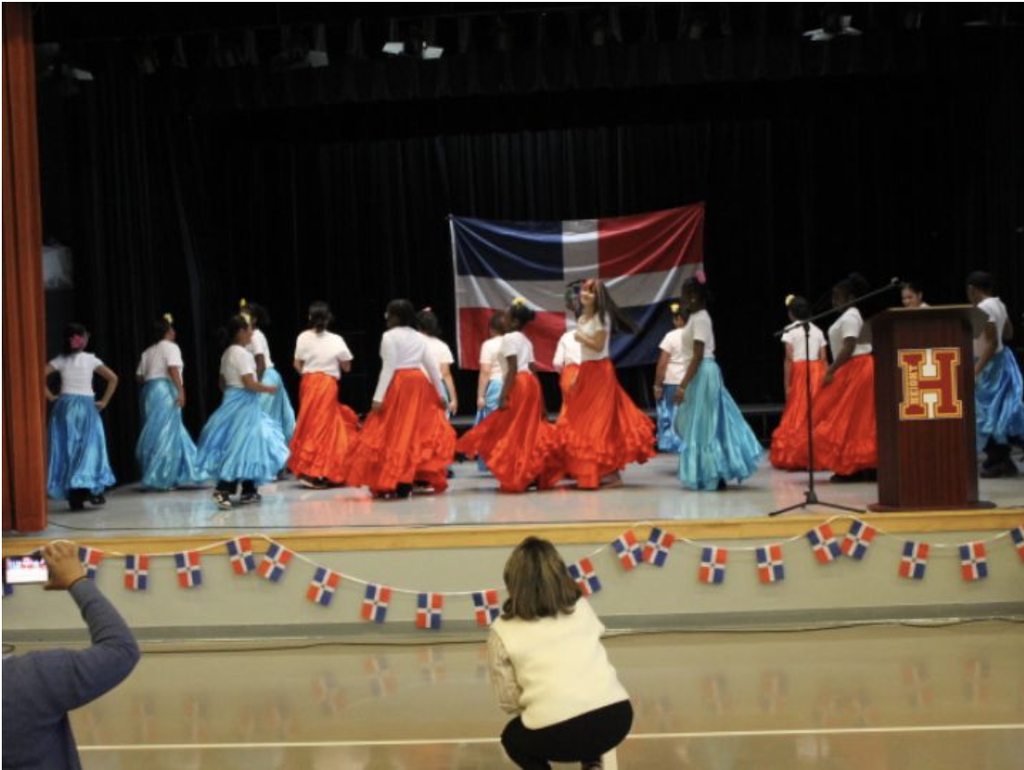
This fall, Crescent City Schools campuses filled with music, color, and a whole lot of flavor. Scholars at Dorothy Height Charter School danced merengue and bachata, Mildred Osborne Charter School scholars made their own maracas and piñatas, and third and fourth graders at Harriet Tubman Charter School took the stage for a special performance. Across the network, Hispanic Heritage Month was a chance to honor the cultures, histories, and families that make CCS home.
At Height, ELL Coordinator Nathalie Cadet said every part of the celebration had a purpose.
“We want them to know the history behind the cultures,” Cadet said.
Hispanic Heritage Month is a yearly tradition across CCS campuses. Every fall, scholars stay after school to rehearse, teachers compete in a door-decorating contest, and the whole school comes together to honor its Hispanic families. But in previous years, Cadet said, much of the celebrations leaned heavily on Honduras, where many Height families have roots.
“In past years, we celebrated Hispanic heritage, but it was always Honduras,” Cadet said. “When we break it into different parts, they also learn about other Hispanic cultures as well.”
Over the summer, Cadet decided Height would spotlight one country each year, starting with the Dominican Republic. The choice was a personal one. Cadet is originally from Haiti, which shares the island of Hispaniola with the Dominican Republic, and the two nations’ histories are closely tied. Starting on the island felt like the right first step, with Mexico, Venezuela, and Bolivia already planned for the years ahead.
The celebration opened by honoring Anacaona, the Taíno queen who led the island before it was divided in two. Scholars then recognized famous Dominicans from baseball players and runners to poets, before taking to the dance floor for merengue and bachata. Teachers found out who won this year’s door-decorating contest, and everyone joined together to sing “We Are the World,” a nod to Height’s theme this year, “We are All IN for Height.”
Afterward, guests headed to the cafe for a Taste of the Dominican Republic, prepared in-house by Height’s kitchen staff. On the savory side, the menu featured pastelitos de carne (similar to Natchitoches meat pies), plantain chips with a dipping station, and mini chimichurri sliders with slaw and sauce. Coconut macaroons rounded things out for dessert.
Bringing it all together took the whole school’s involvement.
“We reached out to the drama teacher, we reached out to the dance teacher, we reached out to the whole enrichment team to help us decorate [and] help us come up with a show,” Cadet added.
Still, she gives the most credit to the scholars.
“We take it very seriously every year,” she said. “Without them, it wouldn’t be possible. They stay after school. They’re eager to practice to come up with a show their teachers can be proud of. Even though English isn’t their first language, they want to share their culture.”
For many of Height’s non-Hispanic scholars, the celebration was also a history and geography lesson.
“A lot of them don’t know where the Dominican Republic is,” Cadet said. “They don’t know if it’s an island, they don’t know the history, or how the island was divided into two.”
Teachers are learning right alongside them.
“When you stop and focus on one culture, it also helps teachers to know, ‘Oh I’m also learning about their culture, the taste of their food, their music,’” she said.
Height serves the largest Hispanic population in the CCS network, with more than 120 scholars in kindergarten through eighth grade. Many of those families find Height through word of mouth.
“We have a lot of Hispanic students at Height, and they definitely need to be seen and heard,” Cadet said.
As ELL Coordinator, Cadet serves as the bridge between those families and their scholars’ classrooms.
“As the ELL Coordinator, it is my responsibility to make the connection between parents and general ed teachers, to make them feel like their kids matter,” she said. “They depend on me to let them know they have somebody that is willing to listen to them, to make them feel like they belong.”
She also sees Hispanic Heritage Month as a matter of equity.
“Just like we honor Black History Month, there should be a time where we really focus on them and celebrate them, because they are a part of our school community,” she said.
At Harriet Tubman Charter School, third and fourth graders put on a special performance for their school community, and multiple staff members at the school worked together to make the month-long celebrations meaningful and engaging for the middle school grades as well. Director of Curriculum and Instruction Gwendolyn Jones found that one element of the Hispanic heritage celebrations was especially popular.
“Scholars definitely enjoyed the authentic food,” shared Jones. “Many scholars tried traditional foods like empanadas and tamales for the first time. One of our parents brought homemade tamales that teachers and scholars could not stop talking about.”
Scholars at Mildred Osborne Charter School marked the week of September 21 under the theme “Unidos Somos Más,” or “Together We Are More,” honoring the contributions of Hispanic Americans throughout American history. The gym was filled with hands-on stations where scholars made their own maracas and piñatas, listened to children’s books by Hispanic authors, and colored portraits of famous Hispanic figures while learning about Día de los Muertos.
Osborne scholars also played Lotería, learned to salsa dance, created Latin rhythms on the drums, and tested their skills at an interactive soccer station. One stop taught the history of paletas, complete with samples from La Chila Ice Cream Company.
“Osborne’s goal in celebrating Hispanic Heritage month is to bring awareness and knowledge of the impact, influence, and contributions the Hispanic community has had in the past and present history of the United States,” shared Beverly Diaz, who is the school’s Dean of ELL.
Cadet said these celebrations matter at every campus, no matter how many Hispanic families each one serves.
“Celebrating our Hispanic students lets the community know that there’s a place for them,” she said. “They know that there’s a place of belonging for them.”
From a bachata step at Height to a paleta at Osborne, this year’s celebrations were a reminder that at CCS, every scholar’s culture has a place — and a story worth sharing.